
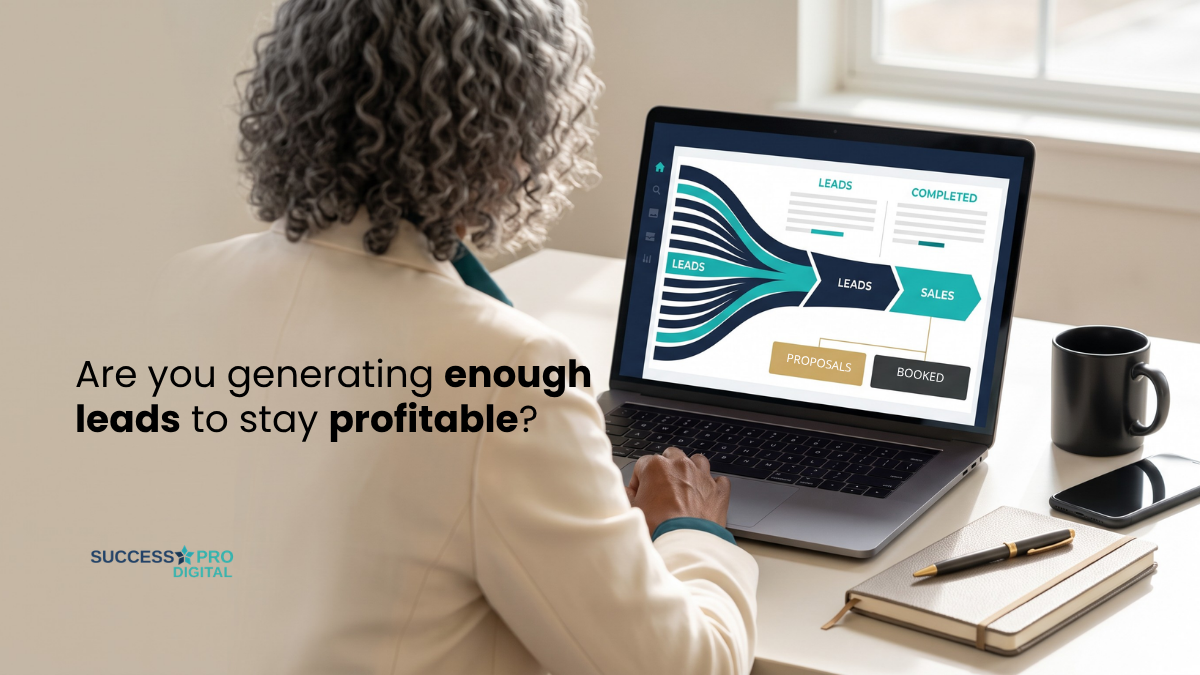
Is your business consistently bringing in enough leads to generate the sales you need to stay profitable?
It sounds like a simple question.
But many small business owners cannot confidently answer it.
They know when sales feel slow. They know when the phone is not ringing often enough, inquiries have dropped, or too many proposals are sitting without a response. They may even know how much revenue came in last month.
What they often do not know is whether the problem begins with the number of leads they are generating—or somewhere else entirely.
That distinction matters.
Because if your business is not producing the sales you need, simply doing more marketing may not solve the problem. You first have to identify where potential customers are getting lost.
When sales slow down, the natural reaction is to try to reach more people.
Post more often. Run an ad. Attend another networking event. Send more emails. Add another social media platform.
Sometimes increased visibility is exactly what the business needs. If too few qualified people know you exist, you cannot expect a consistent flow of leads.
But visibility is only the first step.
Your business may already be reaching enough people, yet still not be generating enough inquiries. Or you may be receiving inquiries but failing to convert enough of them into paying customers.
In those cases, adding more activity pours more people into the same broken process.
Before deciding that you need more leads, look at the entire path a customer takes from first seeing your business to deciding to hire you.
You cannot generate consistent leads if your business is barely visible to the people most likely to need what you offer.
This is the top-of-the-funnel problem most business owners recognize. Your content may not be reaching enough people. Your referral network may have gone quiet. Your website may not appear when someone searches for your service. You may be relying too heavily on one source of business that is no longer producing as it once did.
But the goal is not simply to attract a larger audience. It is to attract more of the right people.
One hundred people who have the problem you solve are more valuable than thousands who were never likely to become customers.
The first question is not just, “Are enough people seeing us?”
It is, “Are enough qualified potential customers seeing us?”

A person can see your business without understanding it.
This is where many businesses lose potential leads without realizing it.
Your content may be attractive. Your website may look professional. You may be showing up consistently. But if people cannot quickly understand what you do, who you help, and why they should care, that visibility will not reliably turn into interest.
Customers should not have to work to figure out whether your service is for them.
Clear messaging helps them recognize their problem in your words. It connects what you sell to an outcome they actually want. It also gives them a reason to keep reading, click, ask a question, schedule a call, or take another step.
If your business is getting views but few inquiries, you may not have a visibility problem. You may have a clarity problem.
Understanding your offer does not automatically make someone ready to buy it.
Potential customers are also asking:
Is this the right solution for my situation?
Can I trust this business to deliver?
What makes this different from my other options?
Is taking the next step worth my time, money, or attention?
Your marketing has to do more than announce that your business exists. It should help people see the value of choosing you.
That does not mean every post should be promotional. It means your content, website, testimonials, examples, and offers should work together to build confidence.
If people understand what you do but still do not act, your business may need stronger proof, clearer differentiation, a more relevant offer, or a better explanation of the outcome you provide.
Sometimes the interest is there, but the path forward is not.
A potential customer clicks through to your website and lands on a page with no obvious next step. A social post raises a real concern but never tells the reader what to do with that information. A contact form asks for too much. A scheduling link is hard to find. An offer requires a phone call when the customer would prefer to begin another way.
Every unnecessary point of confusion gives someone another opportunity to leave.
Review your process from the customer’s perspective. Once they are interested, is it immediately clear what they should do next? Does that next step feel appropriate for where they are in the decision-making process?
Not everyone who discovers your business is ready to buy today. A useful assessment, guide, consultation, or other low-pressure first step can help you capture interest before it disappears.
Generating leads and generating revenue are not the same thing.
If inquiries are coming in but sales are still inconsistent, the problem may be happening after the lead is generated.
Look at what occurs next:
How quickly do you respond?
Are leads being followed up with consistently?
Do your sales conversations connect the service to the customer’s actual need?
Are your proposals clear about value, scope, and next steps?
Do you know why potential customers decide not to move forward?
A business can appear busy while losing revenue through weak follow-up or an unclear sales process.
More leads will not fully solve that. Improving what happens to the leads you already receive may produce a faster and more profitable result.
You do not need a complicated dashboard to begin answering the profitability question. Start with a few basic numbers:
How many qualified leads do you receive in an average month?
What percentage become paying customers?
What is the average value of a new customer?
How many sales do you need each month to cover expenses and produce a profit?
Based on your current conversion rate, how many qualified leads are required to reach that number?
For example, if you need 10 new customers per month and you convert one out of every four qualified leads, you need approximately 40 qualified leads—not just 40 clicks, followers, or website visitors.
Once you know those numbers, you can make a better decision.
You may need more visibility. You may need clearer messaging. You may need a stronger offer or more direct calls to action. You may need to improve your follow-up and sales process. In many businesses, more than one part of the path needs attention.
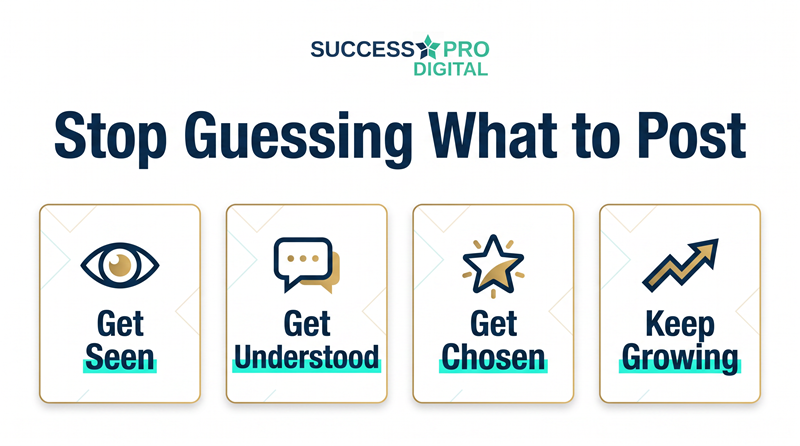
Consistent profitability requires more than getting seen.
The right people have to see your business, understand what you offer, recognize why it matters, feel confident choosing you, and know exactly what to do next. Then your process has to turn enough of those qualified leads into customers.
If your sales are not where they need to be, resist the urge to immediately add more marketing activity.
First ask:
Where, exactly, are potential customers dropping out?
That answer will tell you whether you need more leads—or whether you need to get better results from the attention and opportunities you already have.
If you are unsure where your content may be losing potential customers, start with the free Content Direction Assessment from Success Pro Digital. It can help you identify whether your content needs to do a better job of building visibility, creating understanding, strengthening trust, or guiding people toward the next step.
Small Business Content Strategy: What to Post and Why It Matters
Learn how to choose content that supports your business goals instead of posting just to stay visible.
Content Strategy Assessment
Build a focused 14-day content strategy designed around your business goals.
Success Tips
Explore more ideas to help your business get seen, understood, and chosen.