
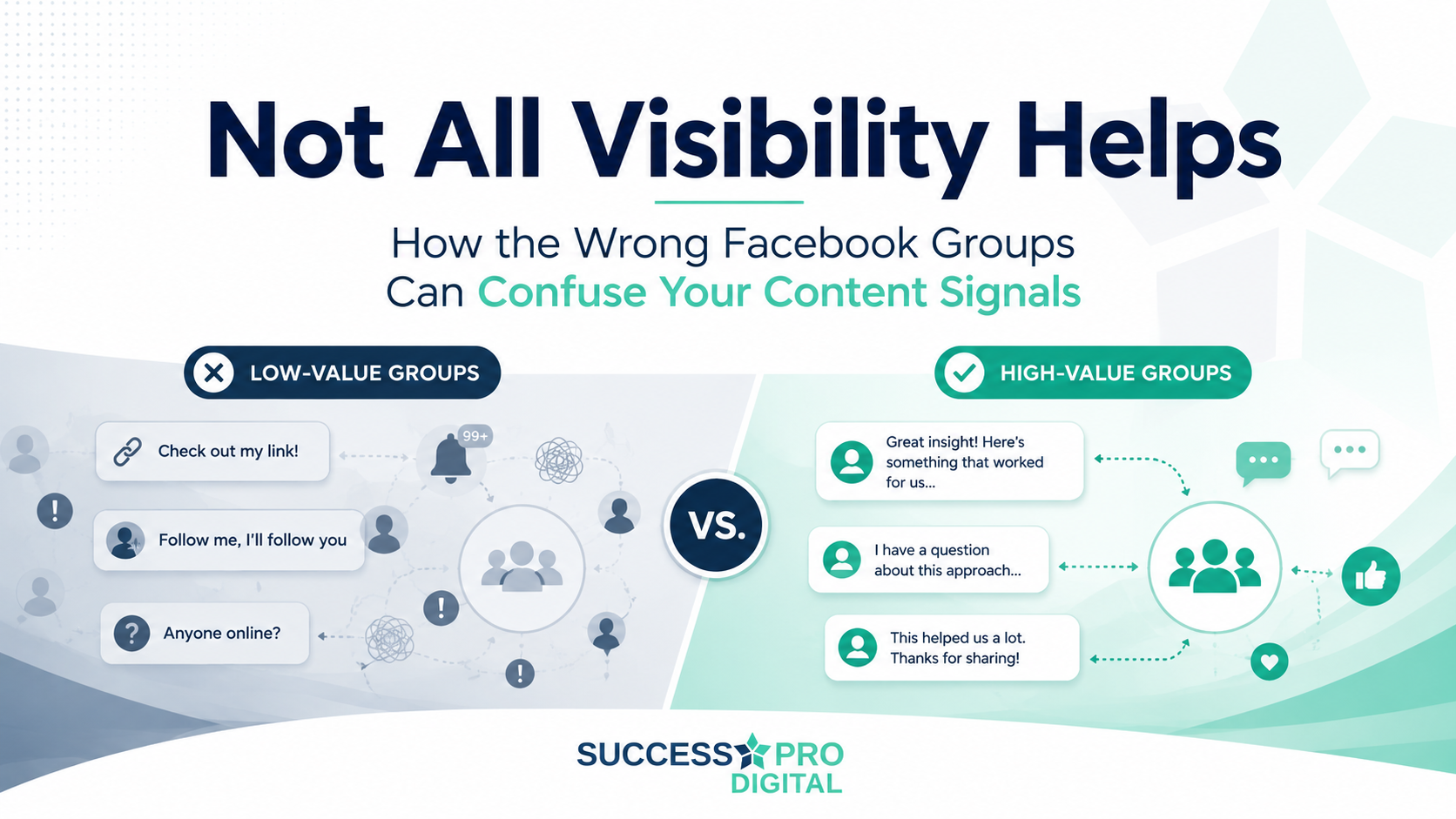
Facebook groups for business can be a powerful way for small business owners to connect, learn, collaborate, and get in front of the right people.
But not every group helps your business grow.
Some groups sound great in the description.
“Support local businesses.”
“Grow your page.”
“Network with other entrepreneurs.”
“Drop your links.”
“Follow for follow.”
At first glance, those groups can feel like an easy way to get more visibility.
But here is the part many business owners miss:
Not all visibility sends the right signals.
And if you are trying to grow your business on social media, the signals matter.
It is tempting to join groups where everyone is sharing links, dropping pages, asking for follows, or promoting their latest offer.
You may get a few likes.
You may pick up a handful of followers.
You may even see a short spike in activity.
But that does not always mean your content is gaining traction with the right audience.
The problem is that many of these groups are not built around real conversation. They are built around exchange behavior.
People follow so they can be followed back.
People like posts so their own posts might get liked.
People comment because they are hoping someone will return the favor.
That may create activity, but it does not always create interest.
And there is a big difference between activity and interest.
Social platforms pay attention to behavior.
They look at who interacts with your content, how they interact, whether they keep engaging, whether they click, whether they come back, and whether your content seems relevant to the people seeing it.
So when your page attracts a lot of random followers or low-intent engagement, it can create a mixed signal.
Your content may start reaching people who are not truly interested in your business.
They may not click.
They may not comment again.
They may not visit your website.
They may not inquire.
They may not become customers.
Over time, this can make it harder for the platform to understand who your content is actually for.
That does not mean one group will ruin your page.
It does mean that chasing the wrong kind of visibility can make your audience messier than it needs to be.
A strong Facebook group is not just a place where people post links.
A good group has real conversations.
You will usually see members asking thoughtful questions, sharing experiences, offering helpful replies, and participating in discussions that are actually connected to the topic of the group.
For a small business owner, that matters.
The right group can help you:
Build trust before selling
Learn what your audience is struggling with
Find collaboration opportunities
Show up as helpful, not spammy
Connect with people who may genuinely need what you offer
Understand the language your audience already uses
That kind of group gives you more than visibility.
It gives you context.
And context is where better content comes from.
Not every group with a good name is a good fit.
Before spending time posting or engaging, look at what is actually happening inside the group.
A weak group may have:
Mostly link drops with no replies
“Follow my page and I’ll follow back” posts
Little to no real discussion
Members only promoting themselves
No clear topic focus
Low-quality engagement that does not continue
Comments that feel copied, forced, or transactional
Lots of posts, but very little conversation
These groups can feel active, but activity alone is not the goal.
If everyone is trying to sell and nobody is paying attention, it is not really community. It is noise.
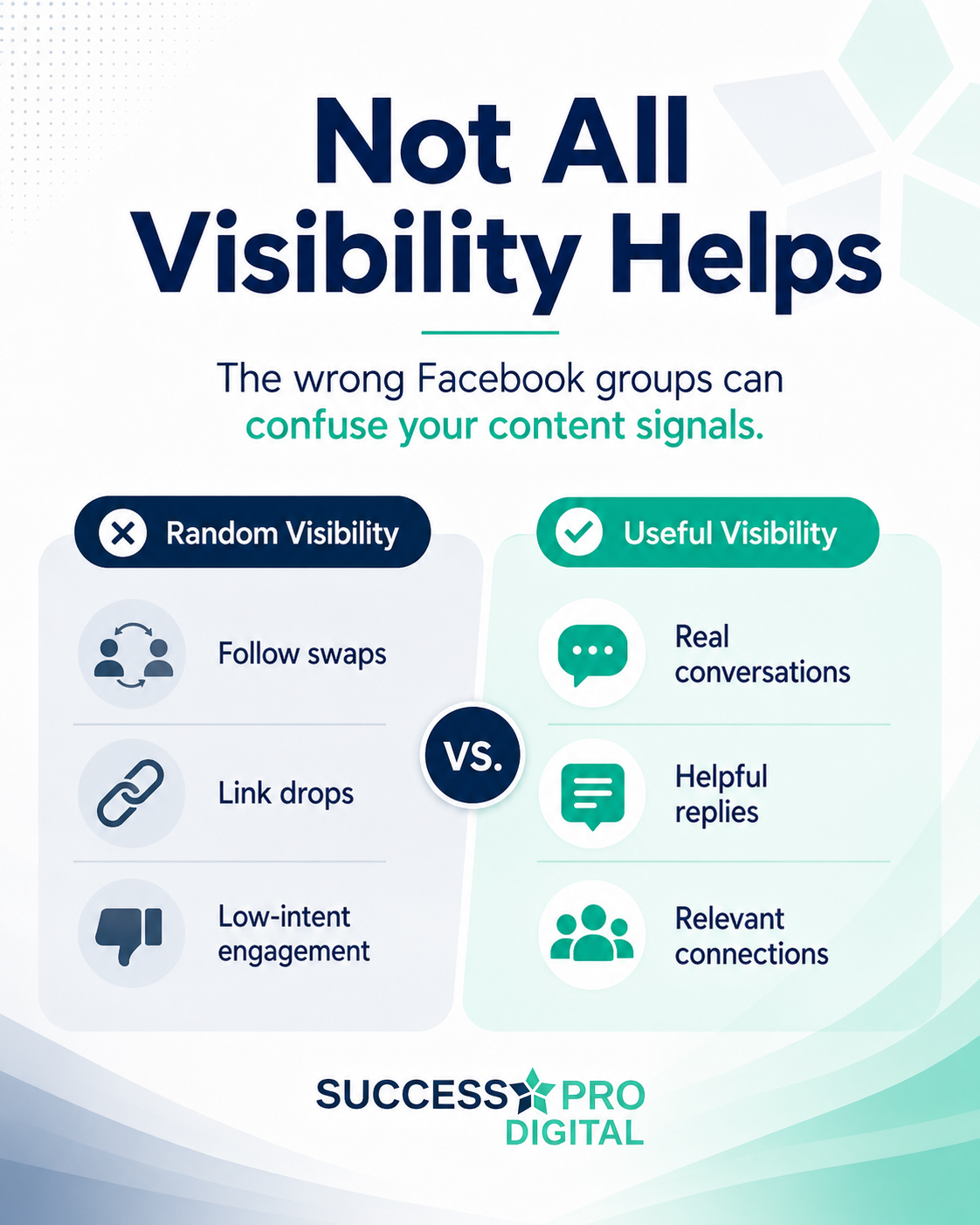
Facebook groups can still be valuable, but the goal should not be to drop your link everywhere.
The better strategy is to look for groups where your presence makes sense.
That may mean local business groups, industry-specific groups, community groups, or niche groups where your ideal audience is already having relevant conversations.
Then participate like a real person.
Answer questions.
Encourage other business owners.
Share useful insight.
Notice what people are struggling with.
Build recognition before asking for anything.
Follow or connect when there is a natural fit.
This is slower than dropping links into a follow thread.
But it is also cleaner.
You are not just trying to get seen.
You are trying to be seen by the right people, in the right context, for the right reason.
More reach is not always better.
More followers are not always better.
More likes are not always better.
If the activity is coming from people who do not care about your offer, your content, your business, or your message, it may not help you move forward.
For small business owners, the goal is not just to be visible.
The goal is to create a path from visibility to trust, and from trust to action.
That action might be a click, a message, a consultation, a booking, a purchase, or simply someone remembering your business when they need what you offer.
But random visibility rarely creates that path.
Clear signals do.
Before spending time in a Facebook group, ask yourself:
Are people having real conversations here?
Is the topic relevant to my business or audience?
Are members engaging beyond link drops?
Would I want these people to shape how the platform understands my page?
Can I show up here in a helpful way without forcing a pitch?
If the answer is no, the group may not be worth your time.
If the answer is yes, that group may become part of a stronger visibility strategy.
Facebook groups are not the problem.
Using the wrong groups the wrong way is the problem.
Some groups can help you build connections, understand your audience, and create meaningful visibility.
Others may only give you random activity that makes your audience harder to read.
So before you chase more exposure, pay attention to where that exposure is coming from.
Because not all visibility helps.
The right visibility gives your content better signals.
And better signals make it easier for the right people to find, understand, and respond to your business.
Getting your business in front of more people isn’t always the goal. What matters is whether your content is attracting the right audience and encouraging the right actions.
The Content Direction Assessment helps identify whether your current content is building meaningful visibility—or simply generating activity that doesn’t move your business forward.