
Small business owners are exhausted.
They’ve been told for years:
“Just post consistently.”
“Show up every day.”
“Keep creating content.”
“Stay visible.”
So they do.
They spend hours making graphics.
Writing captions.
Recording videos.
Trying to “beat the algorithm.”
And then?
Twenty views.
Three likes.
No calls.
No sales.
After months of this, most business owners start assuming the problem is them.
But I don’t think that’s the whole story anymore.

Social media platforms market themselves like free visibility machines.
Post good content.
Stay consistent.
Build an audience.
Grow your business.
But for many small business pages, that is not what actually happens.
What really drives visibility today is often:
Not:
“Post once and customers magically appear.”
That distinction matters.
Because many small business owners are unknowingly treating Facebook like a passive marketing machine when it behaves more like a networking environment.
This is the part people misunderstand.
I don’t think Facebook is useless.
I think many businesses are using it incorrectly because of the expectations they were given.
Facebook still works as:
People may:
That matters.
But that is very different from:
“I posted today, so the platform should automatically send me customers.”
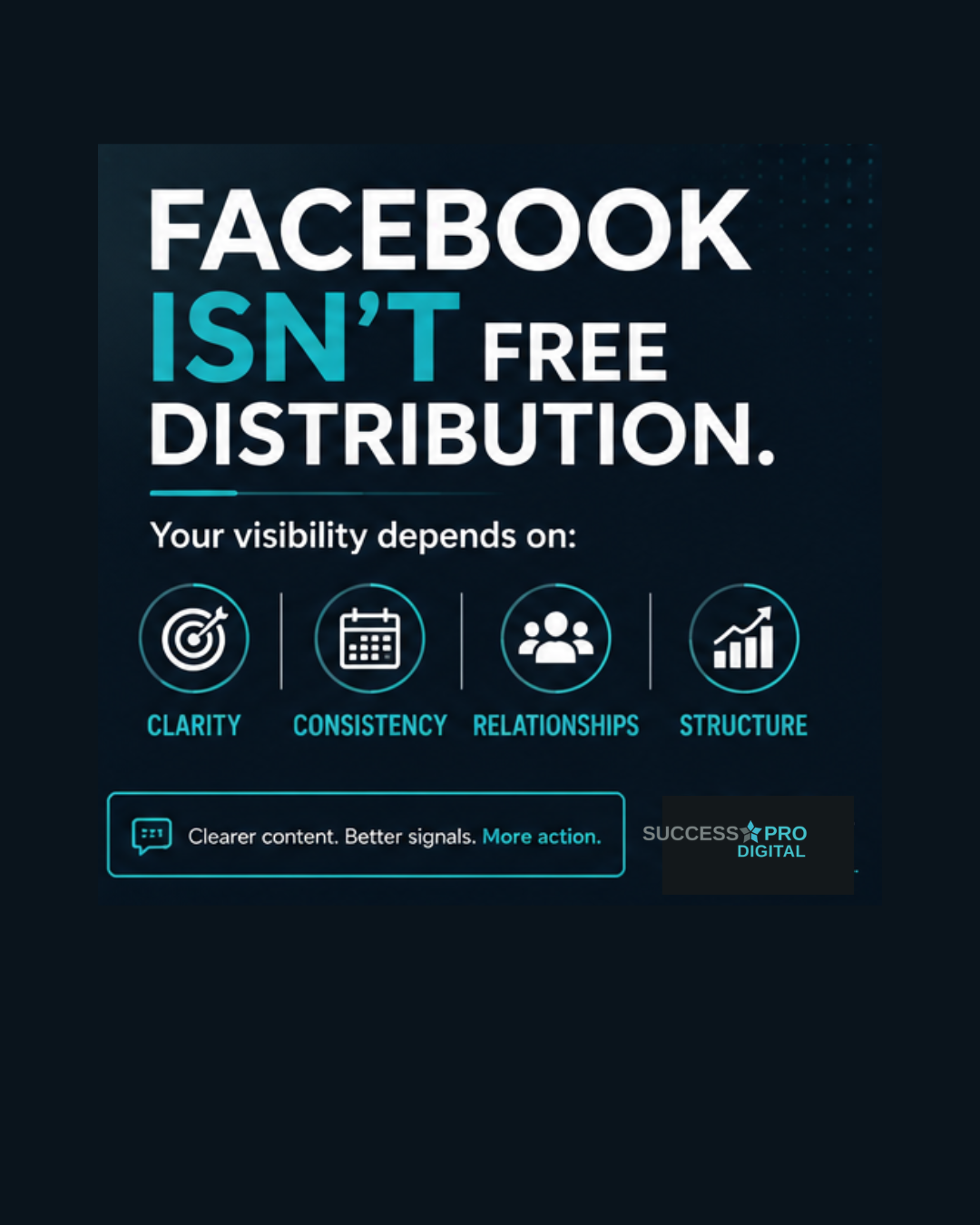
The trap is not social media itself.
The trap is believing visibility happens automatically if you work hard enough.
Many small business owners are doing enormous amounts of unpaid labor for platforms that may only distribute their content to a tiny percentage of followers unless the business creates additional momentum themselves.
That’s why so many owners feel frustrated.
They are not lazy.
They are not failing.
They are often just participating in a system that requires far more relationship-building than they were led to believe.
Instead of obsessing over “beating the algorithm,” small businesses should focus on:
Because in many cases, the businesses quietly winning online are not necessarily the ones posting the most.
They are the ones building trust repeatedly over time.
And that’s a very different strategy than the internet sold people.