
Most small business owners already have a full-time job.
They are serving customers, answering messages, managing schedules, handling payments, solving problems, and keeping the business running.
So when marketing advice says, “Just post more,” it can feel exhausting.
Because for many business owners, content creation does not feel like a simple task. It starts to feel like another job on top of the one they already have.
You know you need to show up online.
You know people need to see what you offer.
You know consistency matters.
But knowing that does not make it easier to sit down and figure out what to post, how to say it, what graphic to use, what caption to write, and what action people should take next.
That is where many small businesses get stuck.
A lot of business owners blame themselves for not posting enough.
But the real problem is often not laziness or lack of effort.
It is lack of structure.
When every post has to be created from scratch, content becomes mentally heavy. You are not just posting. You are making dozens of tiny decisions every time:
What should I talk about?
Will this sound too salesy?
Does this make sense?
Should I add a link?
Is this the right audience?
What am I trying to get people to do?
That is why content starts feeling harder than it should.
Posting more can help, but only when the content has direction.
If your posts do not clearly show who you help, what problem you solve, and what someone should do next, more content may only create more noise.
Small businesses do not need more random posting pressure.
They need content that makes the next step clearer.
That might mean helping people recognize a problem.
It might mean showing why your offer matters.
It might mean making your location, service, or value easier to understand.
It might mean giving people a reason to comment, click, ask, book, or buy.
The goal is not to become a full-time content creator.
The goal is to make your content work harder without making your workload heavier.
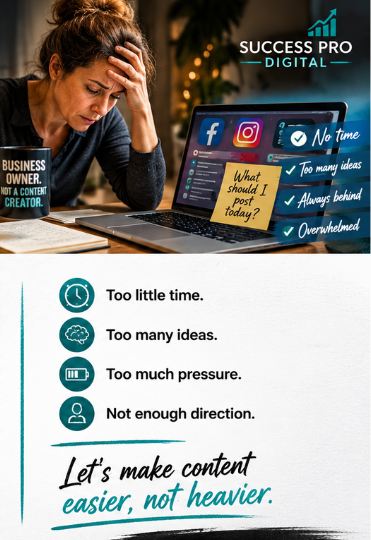
A strong content system reduces the amount of thinking required every time you post.
Instead of asking, “What should I post today?” you can work from a clearer plan:
That structure matters because it gives your content a purpose.
It also makes your marketing feel less random.
Some business owners worry that using prepared content will feel generic.
And it can, if the content is vague or copied from a template that could apply to anyone.
But strong ready-to-use content should not erase your voice. It should give your message a better starting point.
The right content system helps you show up with clearer hooks, stronger captions, better visuals, and more intentional calls to action — without forcing you to build everything from scratch every week.
That is especially helpful for business owners who know they need visibility but do not have the time, energy, or desire to become content strategists.
Your content should not drain the business owner.
It should support the business.
That means your posts should help people understand:
When those signals are clear, your content becomes easier for people to understand and easier for them to act on.
If creating content has started to feel like another full-time job, the answer may not be forcing yourself to post more.
Start by asking:
Does my content make it clear who I help?
Does it explain the problem I solve?
Does it give people a next step?
Does it connect back to my actual offers?
Does it help the right audience recognize themselves quickly?
If the answer is no, you may not need more pressure.
You may need a clearer system.
Small business owners do not need content that adds more stress.
They need content with direction.
When your posts are built around clear signals, stronger structure, and a real next step, showing up online becomes easier — and more useful for the people you are trying to reach.
If you’re tired of wondering what to post every week, Momentum gives you ready-to-use content built around a clear strategy—so you spend less time creating and more time running your business.